As the demand for artificial intelligence (AI) skyrockets, modern data centers are facing unprecedented challenges with rapidly expanding workloads. Industry analysts predict an annual growth in AI-ready data center capacity of 33% from 2023 through 2030. By the end of the decade, it is estimated that approximately 70% of this total demand will involve data centers hosting complex and advanced AI applications.
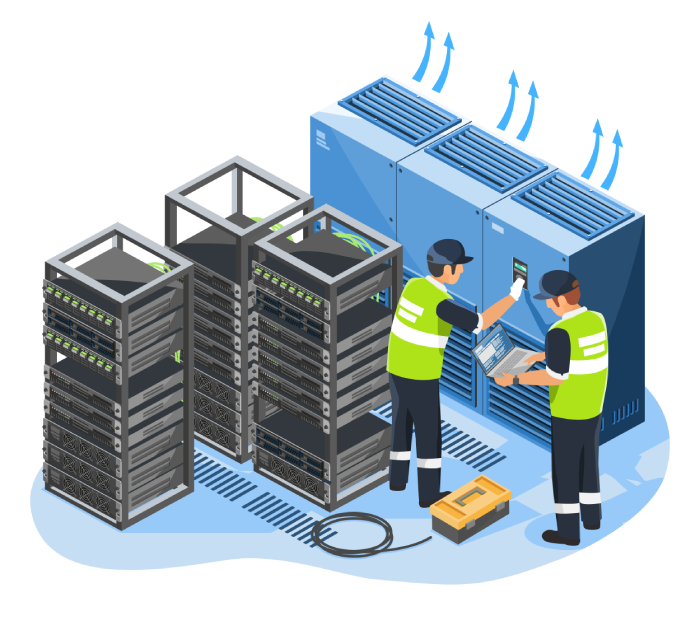
Data centers must evolve to handle the enormous amount of heat being produced by the servers. The development of generative AI, in particular, is driving the growing demand for sustainable and powerful processing structures, such as high-efficiency data center cooling systems. Centrifugal fans will play a greater role as a critical component of AI data center cooling systems. Learn more about the AI impact on data centers and the innovative solutions to their thermal management challenges.
Innovations in Data Center Cooling
To manage increasing heat generation, data centers rely on the following systems:
- Evaporative cooling
- Immersion cooling
- Liquid coils
- Rotational air conditioning
Many of these solutions rely on on-site cooling fans as a key element to data center cooling infrastructure. Whether facilitating airflow in hybrid setups, assisting in heat dissipation for liquid-cooled components, or supplementing air conditioning systems, cooling fans are essential to the thermal management of data centers.
Indirect Evaporative Cooling (IDEC)
Indirect evaporative cooling (IDEC) relies on water evaporation to cool the air flowing through an external air-to-water heat exchanger (radiator). It removes the heat from the data center and provides cooling in the form of chilled cooling fluid. As a closed system, IDEC circulates cool air from within and does not require the use of potable water.
Here’s a breakdown of the process inside the data center:
1. Heat from the data center gets transferred to treated water or other cooling fluid inside the air handling unit (AHU).
2. The AHU utilizes an air-to-water, fan-driven radiator to transfer the heat to the cooling fluid.
3. The now-warm cooling fluid is circulated to the fluid cooler.
Then, here’s what happens outside the data center in IDEC:
1. The fluid cooler utilizes a fan to pull the air through a wet medium, relying on evaporation to cool the air.
2. The cooled air is then passed through a water-to-air heat exchanger, where it transfers the heat to outside air, effectively cooling the fluid and returning it to the data center.
3. If the outside air becomes cold enough, the fluid cooler switches to a dry mode that does not require water.
Direct Evaporative Cooling (DEC)
Direct evaporative cooling (DEC) requires low energy consumption to produce significant humidification and cooling. Using a water-saturated medium, DEC allows a large volume of air to come in contact with the evaporating water. This method is considered the simplest and most cost-effective way to humidify and cool air for data centers.
This advanced technology is utilized by operators in the following scenarios:
- Have direct access to potable water
- Willing to let the data center air combine with outdoor air
- Willing to bring in outside air
Free Air Cooling
Free air cooling techniques use natural outdoor air to effectively control the temperature within the data center. During warm outdoor conditions, the outdoor air dampers remain fully open, and when the air becomes too cold, they close. Inside the building, the return air dampers modulate open to blend in the warm air while maintaining an ideal operating environment.Partner With Pelonis Technologies for Data Center Cooling
Pelonis Technologies, Inc. offers a wide selection of reliable standard and custom high-quality data center cooling fans that can be fully tailored to meet your unique operational needs. Our efficient backward-curved cooling fans run on less horsepower than other models, feature rugged construction for lasting performance, and are highly efficient in high-static-pressure operating conditions.
Contact us or request a quote today to learn more about high-quality data center cooling solutions from Pelonis Technologies, Inc.