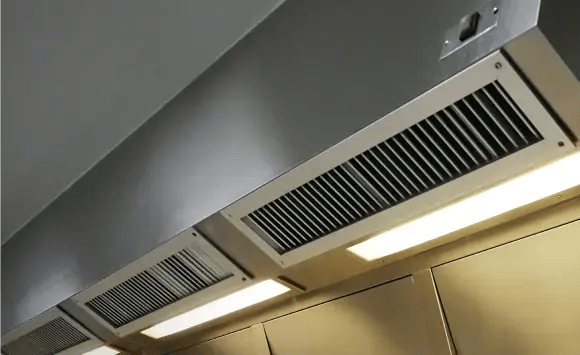
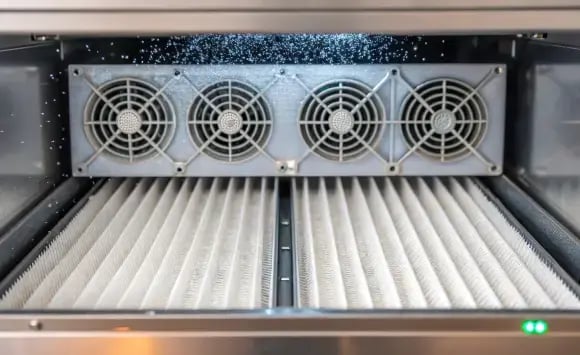
When industrial systems overheat, critical components can degrade faster. This can reduce performance and efficiency and lead to safety risks. In turn, effective thermal management is important to enable and maintain reliable operations across manufacturing plants, data centers, and mission-critical infrastructure.

Pelonis Technologies specializes in high-performance cooling solutions, providing a selection of cooling fans and blowers for a range of industrial environments. As a market leader in thermal innovation, we deliver components that solve complex heat dissipation challenges for aerospace, medical, and automation sectors.

In this guide, we’ll explore the thermodynamics of airflow and the technical differences between an axial and a centrifugal blower. We’ll also look at the different factors to consider in industrial cooling fan selection.
Thermodynamics of Airflow

When electronic components or motors generate thermal energy, the heat must move away to prevent damage. Without active movement, heat builds up in stagnant pockets. Industrial cooling fans facilitate heat transfer by moving air across heat-generating surfaces.

Determining the required cooling capacity involves identifying all heat sources and the airflow volume that is needed. Cooling relies on matching air mass flow rate to heat generation, ensuring efficient exhaust of heated air to maintain low system temperatures.

Other variables that contribute to proper airflow and cooling in industrial applications include:

  • Maximizing the temperature differential between surfaces and cooling air.
  • Optimizing vent placement so fresh intake air reaches critical points.
  • Reducing internal obstructions that create turbulence and parasitic pressure loss.
  • Calculating the specific heat capacity of the air based on local altitude and humidity.

Axial vs. Centrifugal Blower Performance Characteristics

The cooling fan selection process begins with choosing the correct fan architecture.

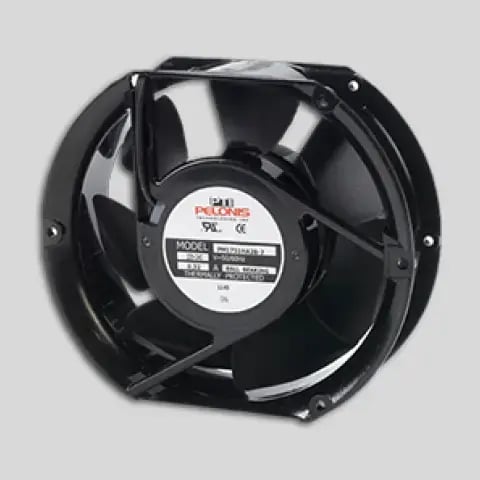
fan_1
fan_2
fan_3
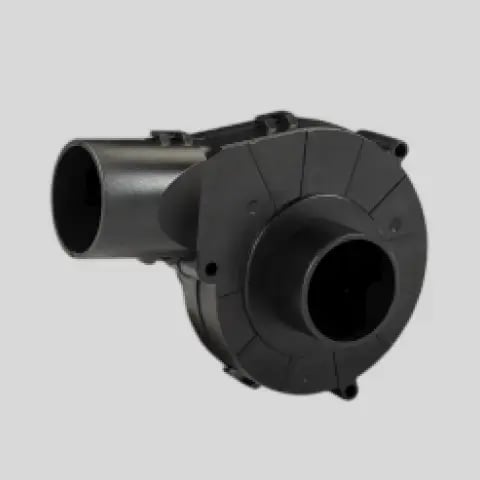
blower_1-1
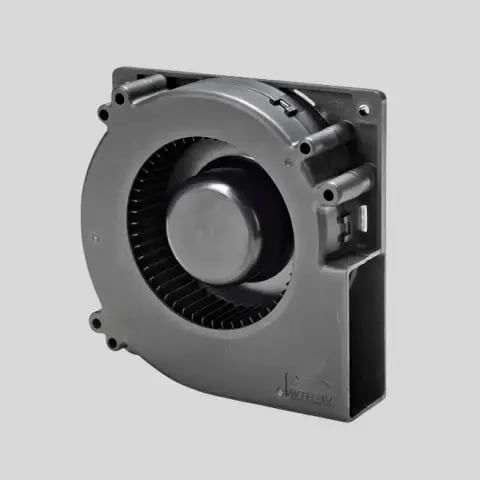
blower_2-1
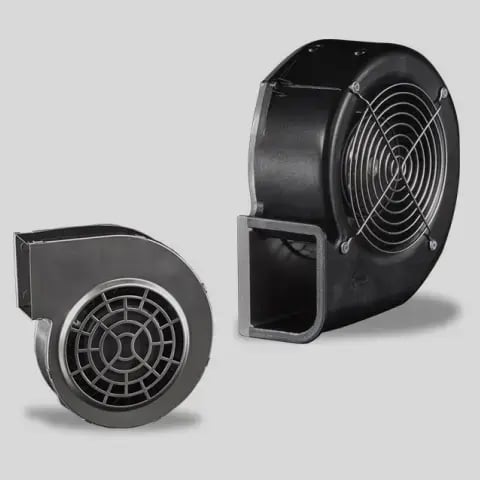
blower_3-1

System Impedance and Air Path Design

System impedance represents the pressure drops air encounters from the fan inlet to the exhaust outlet. Every component in the air path acts as a restriction, and filters can also create significant impedance. Additionally, bends in ductwork can add resistance as the air moves through.

Axial Fans

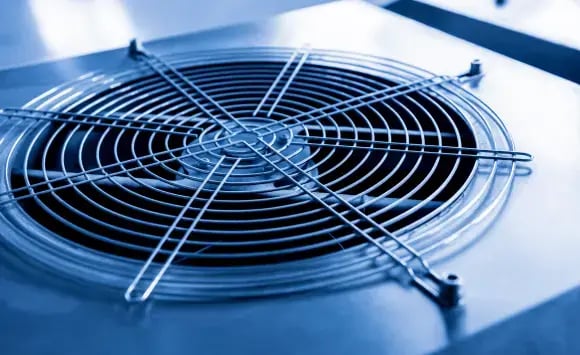
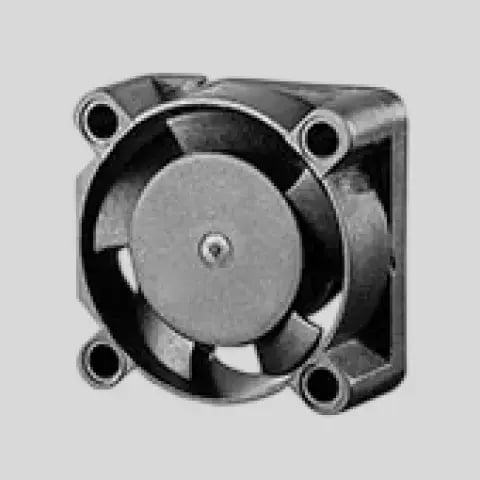
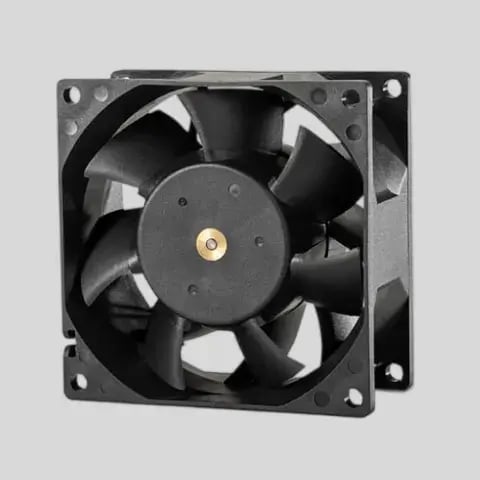
Axial fans move air parallel to the motor shaft, entering and exiting along the same axis. These fans excel in applications that require high airflow volumes against low resistance. They work best for cooling large enclosures with unrestricted air paths. In most cabinet ventilation scenarios, an axial fan is the most energy-efficient choice.

Centrifugal Fans

A centrifugal blower changes airflow direction, with air entering near the shaft center and moving outward through a rotating impeller. Centrifugal blowers are more frequently used in systems with dense heat exchangers or long duct runs.

Fan Performance and Thermal Management

When comparing cooling fan performance, the decision can depend on factors such as system impedance. Low-impedance systems favor axial designs for volumetric efficiency, while high-impedance setups demand the pressure-generating capability of centrifugal blowers. Through offering a range of motor technologies and housing configurations, Pelonis Technologies enables engineers to select a component that optimizes thermal dissipation without over-specifying power consumption.

Fan Efficiency Metrics (CFM/Static Pressure)

When selecting industrial cooling fans, CFM ratings and static pressure are key metrics to take into consideration.

Understanding CFM Ratings

CFM (cubic feet per minute) quantifies volumetric airflow, with actual delivered airflow decreasing as system impedance rises. Design engineers must account for this impedance when they calculate cooling capacity.

The thermal analysis establishes the minimum required airflow based on the total heat load. Professionals can then adjust that CFM requirement upward to compensate for expected system impedance to ensure adequate cooling.

Understanding CFM Ratings

Static Pressure and System Matching

Static pressure measures the ability of a fan to overcome airflow resistance. Static pressure ratings are used to show how much impedance a fan can handle while providing the necessary airflow.

Proper cooling fan selection requires matching the fan's pressure-flow curve to the physical requirements of the system, such as matching higher-pressure fans to applications where the air must move through dense components. To ensure variables align with specific hardware constraints, Pelonis Technologies provides detailed performance data and testing resources that can be used to map system impedance against fan performance curves.

Static Pressure and System Matching

Efficiency Ratings and Operating Costs

Fan efficiency describes the ratio of air power output to electrical power input. Industrial facilities that run industrial cooling fans continuously can reduce their operating costs substantially if they specify high-efficiency models with:

Electronically commutated (EC) motors

Electronically commutated (EC) motors.

These motors combine AC power and DC motor technology to improve cooling efficiency.

Variable speed controls

Variable speed controls

These optimize energy use by reducing fan speed during periods of lower thermal load.

Proper blade geometry

Proper blade geometry

The blade design can reduce turbulence at the tips, which can allow the fan to move more air with less torque.

At Pelonis Technologies, we track the total cost of ownership by combining the purchase price, installation labor, and projected energy consumption. This lifecycle approach often justifies a higher upfront investment.

Acoustic Performance Considerations

Larger, slower-turning fans move equivalent air volumes more quietly than compact, high-speed units. Choosing the right components involves balancing these acoustic limits with the physical space available to meet decibel requirements while accommodating the footprint constraints of the application.

Acoustic Performance Considerations

Contact Pelonis Technologies to Learn More

Industrial thermal management depends on engineering fundamentals rather than guesswork. Successful systems start with rigorous analysis to establish heat loads and impedance. Only then can engineers match fan performance to application requirements.

At Pelonis Technologies, we have spent over 35 years engineering thermal solutions. Our AC fans, DC axial fans, and centrifugal blowers serve manufacturers worldwide. We work directly with project managers to specify components that solve real-world challenges.

Ready to optimize your system? Contact our engineering team for expert guidance on industrial cooling fans.