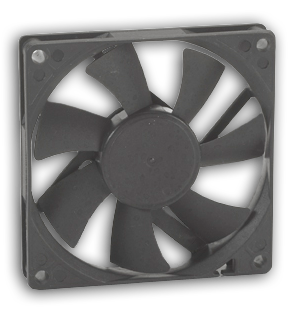
DC Fans

DC Fan Series Application Guide

Fan Series

Fan Sizes

Applications

C Series
25mm to 92mm
(0.98 to 3.62in)
c series fan for standard applications requiring small fan sizes up to 92mm.
Available with multiple features, including auto restart, tachometer, and rotation detection. 5V, 12V, or 24V.
D Series
60mm to 120mm
(2.36 to 4.72in)
c series fan for standard applications requiring higher airflow in fan sizes up to 120mm.
Available with multiple features for improved fan operation and performance including Pulse Width Modulation (PWM). 5V, 12V, 24V, or 48V.
R Series
40mm to 92mm
(1.57 to 3.62in)
c series fan for sensitive applications requiring fan sizes up to 92mm with LOW POWER consumption. Energy efficient DIFFERENTIAL 4-switch circuit design reduces voltage spikes and provides smooth and efficient operation. Available with multiple features, including Pulse Width Modulation (PWM). 24V or 48V.
G Series
92mm to 172mm
(1.57 to 6.77in)
c series fan for demanding applications requiring higher airflow in fan sizes up to 172mm with HIGH AIRFLOW - HIGH PRESSURE - LOW POWER consumption. Available with multiple features for improved fan operation and performance. 24V or 48V.
P Series
92mm to 172mm
(1.57 to 6.77in)
c series fan for demanding applications requiring higher airflow in fan sizes up to 172mm with HIGH AIRFLOW - HIGH PRESSURE - LOW POWER consumption. Available features include Advanced Pulse Width Modulation (PWM) and extra fan features for improved efficiency and performance. 12V, 24V, or 48V.
K Series
80mm to 120mm
(4.72in)
c series fan for very demanding applications in 120mm fan sizes requiring higher performance with EXTRA HIGH AIRFLOW and EXTRA HIGH PRESSURE. Available features include Advanced Pulse Width Modulation (PWM) and extra fan features for maximum performance and efficiency. 12V, 24V, or 48V.

DC Fan Series Quick Selection Guide

Fan Size

inches mm
0.98 x 0.39
1.18 x 0.39
1.57 x 0.39
1.57 x 0.79
1.57 x 1.10
1.97 x 0.39
1.97 x 0.57
2.36 x 0.39
2.36 x 0.79
2.36 x 0.98
2.76 x 0.98
3.15 x 0.59
3.15 x 0.98
3.62 x 0.98
3.62 x 1.26
4.72 x 0.98
4.72 x 1.26
4.72 x 1.50
6.77 x 2.00
25 x 10
30 x 10
40 x 10
40 x 20
40 x 28
50 x 10
50 x 15
60 x 10
60 x 20
60 x 25
70 x 25
80 x 15
80 x 25
92 x 25
92 x 32
120 x 25
120 x 32
120 x 38
172 x 51

CFM

m3/min

inH2O

mmAq

dBA

1.4 - 2.9
2.7 - 4.2
3.9 - 8.0
4.9 - 10.9
8.3 - 24.8
8.1 - 15.7
9.9 - 15.5
11.3 - 17.5
13.8 - 33.3
15.1 - 32.6
19.5 - 35.8
24.5 - 40.7
26.6 - 53.7
40.4 - 77.0
50.5 - 86.1
78.2 - 176.8
80.9 - 239.9
104.5 - 236.8
185.9 - 372.8
0.039 - 0.083
0.075 - 0.120
0.110 - 0.227
0.139 - 0.308
0.236 - 0.703
0.230 - 0.446
0.280 - 0.438
0.318 - 0.497
0.391 - 0.944
0.426 - 0.923
0.551 - 1.012
0.692 - 1.152
0.754 - 1.521
1.145 - 2.180
1.429 - 2.437
2.213 - 5.005
2.293 - 6.794
2.958 - 6.706
5.236 - 10.555
0.078 - 0.315
0.086 - 0.229
0.068 - 0.266
0.094 - 0.342
0.154 - 1.291
0.070 - 0.279
0.097 - 0.274
0.054 - 0.121
0.109 - 0.606
0.129 - 0.576
0.074 - 0.246
0.072 - 0.198
0.074 - 0.286
0.095 - 0.338
0.157 - 0.458
0.207 - 0.976
0.247 - 1.229
0.286 - 1.239
0.275 - 1.272
1.98 - 8.00
2.19 - 5.82
1.73 - 6.75
2.40 - 5.74
3.91 - 32.79
1.78 - 7.09
2.45 - 6.96
0.054 - 0.121
0.109 - 0.606
0.129 - 0.576
0.074 - 0.246
0.072 - 0.198
0.074 - 0.286
0.095 - 0.338
0.157 - 0.458
0.207 - 0.976
0.247 - 1.229
0.286 - 1.239
0.275 - 1.272
18 - 34
18 - 29
19 - 37
21 - 32
32 - 61
26 - 40
26 - 39
25 - 35
25 - 47
26 - 46
25 - 41
27 - 40
24 - 41
28 - 46
32 - 45
37 - 58
37 - 65
40 - 65
47 - 66


3 dc fans

The following points should be considered when selecting a cooling fan:

  1. Determine the amount of heat generated inside the equipment.
  2. From the equipment manufacturer's data, find the maximum permissible equipment temperature.
  3. Calculate the air volume necessary from the equation.
  4. Select the fan from the performance curves shown in the fan specification sheets. The volume of airflow required to cool the equipment can be determined if the internal heat dissipation and the total allowable temperature rise are known.

The basic heat transfer equation is:

Q = Cp x W x T

Where:

Q = Amount of heat transferred
Cp = Specific heat of air
T = Temperature rise within the cabinet
W = Mass flow = CFM x D
(Where: D = Air Density and CFM is cubic feet / min)
By substitution, we obtain:
Air Flow in CFM = Q
Cp x D x T

Then, we get the following equations:

Air Flow in CFM = 3.16 x P = 1.76 x P
Tf Tc
Air Flow in m3/min = 0.09 x P = 0.05 x P
Tf Tc
P : Internal power dissipation in watts
Tf : Allowable temperature rise in °F
Tc : Allowable temperature rise in °C
T : T2 - T1
T1: Incoming airflow temperature
T2: Outgoing airflow temperature
1 m3 / min = 35.325 CFM (Cubic Feet / min)
COOLING OF HEAT GENERATING EQUIPMENT
Example 1: If internal power dissipation is 1500W and T is 50°F
equipment power dissipation
Air Flow in CFM = 3.16 x 1500 = 94.8 CFM (or 2.68 m3/min
50
Example 2: If internal power dissipation is 1000W and T is 20°C
Air Flow in CFM = 0.05 x 1000 = 2.5 m3/min (or 88.3 CFM)
20